
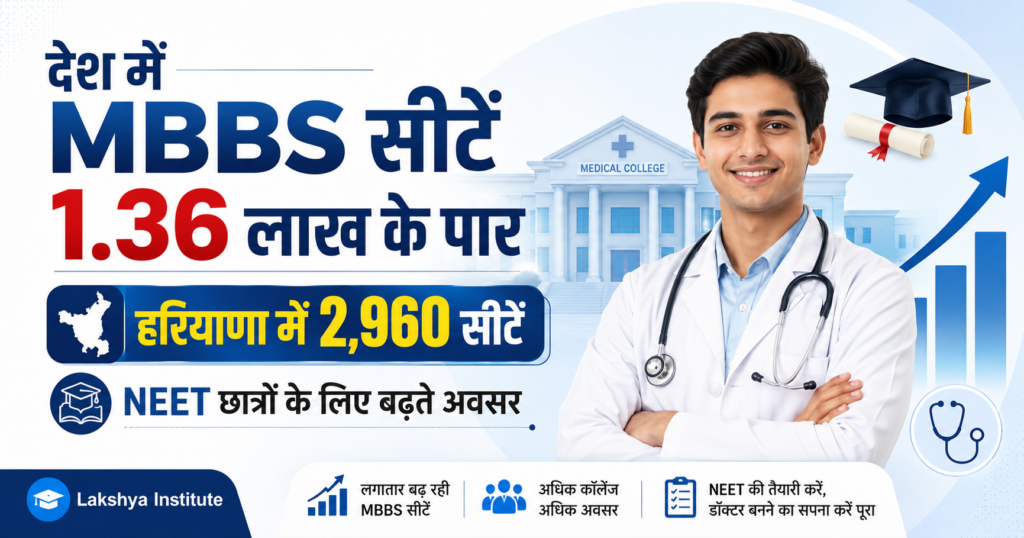
A parent-friendly guide to the latest NMC MBBS seat matrix, Haryana’s growth and the preparation strategy students still need.
| Publishing note: The July 2026 NMC matrix lists 1,36,939 seats across 823 colleges, excluding Institutes of National Importance (INIs). The matrix may be revised; candidates should recheck NMC and counselling portals before choice filling. |
Introduction
For students dreaming of becoming doctors, the latest update on MBBS seats in India is genuinely encouraging. According to the National Medical Commission’s seat matrix for the 2026–27 academic session, 823 medical colleges together have an approved intake of 1,36,939 MBBS seats. The matrix covers 441 government and 382 private medical colleges. It does not include Institutes of National Importance such as AIIMS and JIPMER, whose seats are handled separately.
For families in Gurugram and across Haryana, the state figure is especially relevant: Haryana now has 2,960 seats, including 1,060 in government colleges and 1,900 in private colleges. That is a major change from the 700-seat base reported for 2013–14. More capacity means more possible routes into medicine—but it does not turn MBBS admission into an easy contest.
NEET 2026 had approximately 22.79 lakh registered candidates, according to the National Testing Agency. Even when the broader set of MBBS seats is considered, demand remains many times greater than supply. A seat increase improves opportunity at the margin; it does not remove the need for a strong score, intelligent counselling and a realistic financial plan.
Latest MBBS Seat Increase in India
The headline number—1,36,939 NMC MBBS seats—is the largest approved capacity shown in the July 2026 matrix. It represents 1,27,028 renewed seats plus 9,911 newly approved seats. Of these additions, 2,400 seats came through 25 new medical colleges, while the remaining additions came largely from higher intake at existing institutions.
| Indicator | Previous / renewed base | 2026–27 NMC matrix | Change |
| Medical colleges | 818 reported last year | 823 | +5 net colleges |
| MBBS seats | 1,27,028 renewed base | 1,36,939 | +9,911 |
| Government seats | 61,185 | 63,296 | +2,111 |
| Private seats | 65,843 | 73,643 | +7,800 |
Why do some reports mention 7,963 additional seats? That figure is obtained by subtracting a separately reported last-year total of 1,28,976 from 1,36,939. The official 2026–27 release, however, uses the renewed base of 1,27,028 and labels 9,911 seats as additions. For an accurate blog, the two calculations should not be mixed. The safest statement is: the current NMC matrix totals 1,36,939 seats, comprising 1,27,028 renewed seats and 9,911 additions.
Government medical colleges: 441 colleges with approximately 63,296 seats.
Private medical colleges: 382 colleges with approximately 73,643 seats.
New colleges: 25 institutions contributing 2,400 seats—400 government and 2,000 private.
Important limitation: AIIMS, JIPMER, PGIMER and other INIs are outside this particular NMC matrix.
State-wise Highlights
The distribution of medical colleges in India is uneven. A student’s admission chances depend not only on the national total but also on domicile rules, reservation, college type, fees, bond conditions, All India Quota availability and the closing ranks in each counselling round.
| Rank / region | MBBS seats in 2026–27 | What students should notice |
| 1. Karnataka | 15,395 | Highest total; large private-college share |
| 2. Uttar Pradesh | 14,000 | Large government and private ecosystem |
| 3. Tamil Nadu | 13,999 | Substantial public and private capacity |
| 4. Maharashtra | 13,099 | Highest government-seat count reported |
| 5. Telangana | 10,250 | Strong private-college presence |
| Haryana | 2,960 | 1,060 government + 1,900 private |
| Punjab | 1,850 | 900 government + 950 private |
| Chandigarh | 200 | Government seats in the NMC matrix |
Karnataka leads the country, followed by Uttar Pradesh, Tamil Nadu, Maharashtra and Telangana. For a Haryana student, nearby options in Delhi, Punjab, Chandigarh, Rajasthan and Uttar Pradesh may also be relevant, but eligibility and state-quota rules must be checked separately. A national figure never means every student can access every seat on identical terms.
Haryana’s Growth in Medical Education
Haryana’s rise from about 700 MBBS seats in 2013–14 to 2,960 in the current matrix is a remarkable expansion—more than four times the earlier capacity. The 2026–27 total places Haryana around 10th nationally by the figures cited in the state report. It also exceeds Punjab’s 1,850 and Chandigarh’s 200 seats.
This growth benefits the state in several ways. It creates more local training capacity, supports hospitals with interns and future doctors, reduces some dependence on distant states and gives Haryana-domicile candidates a broader state-counselling pool. It can also encourage students from Gurugram, Rewari, Jhajjar, Faridabad and nearby districts to view medicine as a more visible and attainable career.
| What parents must examine: Seat count is only the first filter. Compare tuition and hostel costs, bond or service obligations, hospital patient load, faculty, recognition status, campus safety, location and the latest counselling rules before building a preference list. |
Does More MBBS Seats Mean Easier NEET Admission?
The honest answer is: slightly more opportunity, but not easy admission. NEET is a rank-based national competition. If seats rise but the number of serious candidates, their preparation quality and their scores also rise, the competition for a desirable government medical college can remain intense.
With roughly 22.79 lakh registrations for NEET 2026 and 1,36,939 seats in this NMC matrix, there were still around 16.6 registered candidates for every listed seat. This is only a simple scale comparison—not an admission probability—because the numerator includes candidates with different eligibility and preferences, while the denominator excludes INIs and includes private seats with very different fee structures. Nevertheless, it shows why students cannot rely on seat expansion alone.
Government seats remain the most sought-after because fees are generally lower.
Private medical college seats may be financially inaccessible to many families.
Category, domicile, quota, gender rules where applicable and counselling choices affect closing ranks.
Seat additions can soften closing ranks in some colleges or later rounds, but no uniform cutoff fall is guaranteed.
Students must qualify NEET and then complete counselling, document verification and choice filling correctly.
How Students Should Prepare for NEET 2026
For students awaiting counselling, preparation now means tracking official notices, arranging documents and studying past closing ranks—not restarting the examination syllabus. For students targeting the next NEET attempt, the following NEET preparation strategy is practical and measurable.
1. Build the plan around NCERT
Biology and Inorganic Chemistry require repeated, line-by-line NCERT revision. Physics and Physical Chemistry need concept clarity followed by disciplined problem practice. Do not allow reference books to replace the core text; use them to deepen or test what the syllabus requires.
2. Convert every chapter into testable recall
After class, close the book and write the formulas, diagrams, exceptions and key concepts from memory. Maintain one-page smart notes, an error log and a short list of questions that exposed a misconception. Active recall is more reliable than repeatedly highlighting the same pages.
3. Use tests as diagnosis, not judgement
A test score is valuable only when it changes the next week’s study plan. Classify every lost mark: concept gap, memory gap, calculation error, misreading, poor time allocation or guesswork. Retest weak chapters after correction. Regular part tests should gradually lead to full-syllabus papers in exam conditions.
4. Set score and accuracy milestones
Track attempted questions, correct answers, negative marks, time per subject and chapter-wise accuracy. A student improving from 65% to 80% accuracy is making real progress even before the final score stabilises. Parents should discuss the trend and action plan rather than reacting emotionally to one test.
5. Protect consistency
Medical entrance preparation is won through ordinary days repeated well: attending class, revising within 24 hours, completing daily practice, sleeping adequately and correcting tests. Long study hours without concentration are less useful than shorter, planned blocks completed honestly.
Why Early Preparation Matters
Students in Classes 9 and 10 do not need to study the full NEET syllabus prematurely. They need strong foundations: scientific reading, algebra, graphs, unit conversion, basic chemistry, biological terminology and the habit of revising regularly. Foundation courses should reduce future difficulty—not create unnecessary pressure.
In Classes 11 and 12, the school and NEET syllabi overlap substantially, but the depth and speed of application differ. Beginning early allows time for three essential cycles: concept learning, chapter-wise practice and full-syllabus revision. A late start often forces students to choose between completing the syllabus and revising it; an early start allows both.
How Lakshya Institute Helps NEET Aspirants
Lakshya Institute, New Railway Road, Gurugram, supports students through structured medical entrance preparation rather than disconnected lectures. The objective is to make each week visible: what was taught, what the student practised, what the test revealed and what must improve next.
Concept-focused Physics, Chemistry and Biology teaching aligned with NEET requirements.
NCERT-centred Biology and Chemistry revision with important lines, diagrams and exceptions.
Regular chapter tests, cumulative tests and performance analysis.
Doubt support and personal mentoring for academic or consistency problems.
Smart Notes and active-revision routines to improve retention.
Parent communication so attendance, test trends and corrective action stay visible.
Families searching for NEET coaching in Gurugram or comparing the best NEET coaching options should ask a simple question: does the system measure learning between classes? Good medical entrance preparation needs teaching, revision, practice, testing and feedback to operate as one cycle.
Key Takeaways
The July 2026 NMC matrix lists 1,36,939 MBBS seats across 823 colleges, excluding INIs.
The official release describes 1,27,028 renewed seats and 9,911 additions.
Government colleges account for about 63,296 seats; private colleges account for about 73,643.
Haryana has 2,960 seats—1,060 government and 1,900 private—up sharply from about 700 in 2013–14.
More seats are positive, but NEET competition remains severe because candidate numbers remain very high.
A strong score, realistic college and fee planning, correct counselling and disciplined preparation are all essential.
Frequently Asked Questions
1. How many MBBS seats are there in India for 2026–27?
The NMC seat matrix released in July 2026 lists 1,36,939 MBBS seats across 823 medical colleges. This matrix excludes Institutes of National Importance such as AIIMS and JIPMER, so students should also follow their applicable counselling information.
2. How many new MBBS seats were added for 2026–27?
The official NMC presentation identifies 9,911 additions over a renewed base of 1,27,028 seats. Some reports calculate 7,963 by comparing the new total with a different prior-year figure of 1,28,976. For consistency, use the official renewed-plus-added calculation.
3. How many Haryana MBBS seats are available?
The current matrix lists 2,960 Haryana MBBS seats: approximately 1,060 in government medical colleges and 1,900 in private medical colleges. Candidates must verify the final seat matrix and quota rules during Haryana counselling.
4. Will the increase in seats lower the NEET 2026 cutoff?
It may affect closing ranks in some colleges, categories or counselling rounds, but a lower cutoff is not guaranteed. Cutoffs depend on paper difficulty, candidate performance, reservation, domicile, preferences, fees and the final number of available seats.
5. Is a government medical college always better than a private medical college?
Not automatically. Government colleges are usually preferred for lower fees and often strong patient exposure, but quality differs by institution. Families should assess recognition, hospital load, faculty, infrastructure, location, bond conditions and total cost.
6. Are all 1,36,939 seats available through one counselling process?
No. MBBS admission is distributed across MCC counselling, state counselling and applicable institutional or deemed-university pathways. Quota and eligibility rules vary. The NMC matrix also excludes INIs in this release.
7. When should a student begin NEET preparation?
Classes 9–10 are ideal for building foundations and disciplined study habits. Focused NEET preparation typically becomes more intensive in Class 11. A student starting later can still succeed, but needs a realistic plan, close monitoring and efficient revision.
8. What is the most important NEET preparation strategy?
Use a closed learning loop: learn the concept, revise from NCERT, practise questions, take a timed test, analyse every error and retest weak areas. Consistency and correction matter more than collecting many books or watching unplanned lectures.
Conclusion: More Opportunity, Same Need for Discipline
The growth of MBBS seats in India is a positive development for students and parents. Haryana’s expansion to 2,960 seats is particularly encouraging for medical aspirants in Gurugram and nearby districts. It shows that India’s medical education capacity is moving in the right direction.
But seat growth should create hope, not complacency. Success still depends on disciplined preparation, proper guidance, regular testing, careful analysis and consistent performance in NEET. The student who builds strong concepts, revises repeatedly and learns from every test will be best placed to convert a larger opportunity into an actual MBBS admission.
| Call to action: Planning for NEET or building an early science foundation? Visit Lakshya Institute, New Railway Road, Gurugram, for a diagnostic academic discussion and batch guidance. Call or WhatsApp 8058055100 to enquire about NEET batches, Foundation Courses, Test Series and the Scholarship Test. |
Internal Link Suggestions
| Suggested anchor text | Best placement | Link destination |
| NEET Coaching Program in Gurugram | First Lakshya section paragraph | NEET course landing page |
| Foundation Courses for Classes 8–10 | Why Early Preparation Matters | Foundation course page |
| NEET Test Series | Testing strategy / Lakshya benefits | Test series page |
| Lakshya Scholarship Test | Final call-to-action | Scholarship test page |
| NEET preparation blogs | After Key Takeaways | Blog category/archive |